
While many business processes have evolved through digitization, printing often lags behind — creating gaps in visibility, efficiency, and control. Many organizations still have fragmented device fleets, undefined policies, and limited data into usage or costs.
As a result, teams can lose time to troubleshooting, IT teams often lack the tools to optimize, and leaders lose sight of the bigger picture: where printing adds costs, risk, or inefficiency.
That’s why organizations are shifting towards centralized print management. By consolidating print device control into a single view, businesses can turn printing from a disconnected function into an integrated, data-driven operation that supports stronger governance, reliability, and performance across every location.

Benefits of centralized print management for businesses
As organizations move from fragmented to integrated print operations, centralized print management delivers measurable business value. Here are some of the key benefits.
Cost savings
Centralized print management reduces costs by enforcing print defaults like duplex and black-and-white printing and reducing unclaimed jobs through secure print release. It also helps identify underused or redundant devices, consolidate service contracts, and reduce support and infrastructure costs through automation and cloud-based management.
Improved efficiency and productivity
Remote monitoring and standardized configurations help IT resolve issues faster and reduce manual upkeep. Employees experience fewer interruptions and consistent access across locations — contributing to smoother workflows and better overall productivity.
Enhanced control and security
By applying consistent security policies and requiring authentication at devices, centralized print management reduces the risk of unauthorized access. It also simplifies compliance by making activity tracking, audit reporting, and data protection easier to enforce and verify.
Scalability and future readiness
A centralized platform can scale quickly as organizations grow or adapt to evolving workplace models. New devices, locations, and users can be added without complex setup — keeping print infrastructure flexible and consistent.
Sustainability and environmental impact
With greater visibility into print activity, organizations can track and reduce paper, toner, and energy usage. Analytics make it easier to measure progress toward environmental targets and encourage responsible printing habits across teams.
Centralized vs. decentralized print management
As organizations evaluate how best to manage printing, the question often shifts from "Why centralize?" to "How does it differ from what we have today?"
Centralized environments typically feature standardized device profiles and data-driven reporting, designed to make print practices a value to the organization while establishing consistency and scalability. Decentralized environments have a tendency to evolve organically — offering local control but at the expense of efficiency, cost control, and organizational oversight.
Understanding these differences helps leaders determine which approach aligns best with operations and strategic needs. Both models shape how devices, policies, and workflows are managed, each with distinct advantages and considerations.
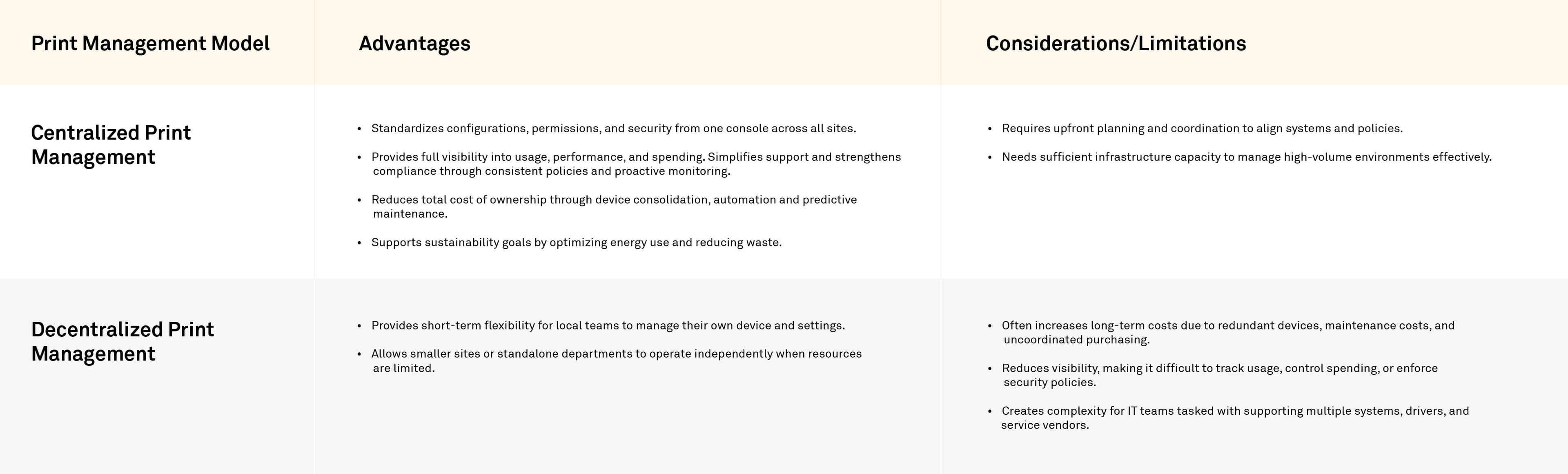
Both approaches have their place, but as organizations grow and prioritize governance, the balance naturally shifts toward centralized print management.
Let’s take a closer look at some of the common challenges that arise in decentralized print environments.
Challenges of decentralized print management
Decentralized print environments may support short-term needs for flexibility and local control, but as printer fleets grow, the drawbacks become more visible. Without unified oversight, departments make independent print management decisions against budgets, but without visibility into wider business and operational considerations. This can create inefficiencies, higher costs, and present greater exposure to risk.
Here's a summary of the most common challenges.
Hidden cost and lack of visibility: Seemingly affordable at first, unmanaged device purchases, maintenance contracts, and supply orders make it difficult to identify or prevent overlapping expenses, driving costs up over time. Limited visibility of device usage is also an issue.
Operational inefficiencies and workflow disruptions: Updating devices and drivers becomes a challenge for IT and management teams; managing devices is often time-consuming and manual. Employees may experience greater downtime when devices need supplies or service, reducing productivity.
Security and compliance vulnerabilities: Disparate print environments make it difficult to enforce consistent data protection with unsecured devices, outdated firmware, or unmonitored print queues increasing the risk to confidential information and for compliance violations.
In industries governed by strict regulations — such as healthcare, finance, or government — these gaps can have serious implications for data privacy and audit readiness.
By contrast, a centralized print management model eliminates many of these pain points by providing unified control, consistent security, and clear accountability — helping organizations manage costs, strengthen performance, and safeguard information more effectively.
Factors to consider when choosing a print management strategy
Selecting the right print management approach depends on an organization’s goals, resources, and long-term vision. While every environment is unique, several key factors can help determine which model delivers the greatest operational and strategic value.
Organizational structure and scale
How widely dispersed operations are — whether across multiple sites, regions, or countries — shapes the type of print management model that works best. Larger, multi-site operations often benefit from a unified framework that can enforce consistent standards without adding administrative layers.
Regulatory and risk exposure
Organizations subject to privacy, audit, or retention requirements must ensure that security controls are applied and verified consistently. Decentralized models often struggle to maintain uniform compliance across locations.
IT capacity and service model
Evaluate how much in-house expertise and time IT teams can realistically dedicate to device management, troubleshooting, and updates. A centralized approach can reduce that burden through automation and remote support.
Sustainability commitments
Consider how print policies contribute to environmental goals. Standardization defaults and usage data make it easier to track and reduce energy and paper consumption company-wide.
Future readiness
As technology, workforce distribution, and business models evolve, centralized management provides a stable foundation that can adapt to new tools, locations, and hybrid work patterns.
Choosing the right strategy ultimately means aligning print management with organizational priorities for efficiency, governance, and growth.
Implementing centralized print management solutions
Transitioning from decentralized printing to a centralized model requires more than technology — it involves aligning people, processes, and policies under a shared framework. A structured, phased approach helps minimize disruption while maximizing long-term results.
Here are some best practices to help guide a smooth move from decentralized to centralized print management.
Assess the baseline: Conduct a comprehensive audit of existing devices, print volumes, service contracts, and workflows to identify inefficiencies and redundancies. This assessment creates a foundation for right-sizing devices and optimizing placement.
Develop a unified strategy: Define governance policies, security standards, and cost-saving rules that will apply across all locations. Engage key stakeholders early to ensure alignment with business goals and compliance requirements.
Standardize infrastructure: Consolidate printer models and vendors where possible, retiring redundant devices to simplify maintenance and support. Choose a centralized management platform that integrates with your workflows and identity systems and supports secure print release capabilities.
Deploy in phases: Start with a pilot program in high-volume location or departments where the benefits will be most visible, then expand gradually as users adapt and feedback is incorporated.
Communicate and train: Provide clear communication, hands-on training, and structured change management to help users and administrators transition smoothly to the new model.
Monitor and optimize: Use analytics to track usage, uptime, and supply levels. Incorporate proactive monitoring and automated firmware updates, and regularly review security posture, fleet management, and policy compliance to maintain performance and reduce risk.
Engage a trusted partner: Work with experienced providers who can offer ongoing optimization, audits, and workflow innovation — such as scan-to-cloud or mobile print capabilities — to keep operations efficient and future-ready.
Managed print services and centralized print management
In a managed print services engagement, your print provider becomes a partner in centralizing and managing print across the organization. Services range from basic management and output reporting to becoming a full transformation partner, becoming an extension of the organization with a solution that blends technology, on-site staff, and device management and support.
A full transformation partnership often includes applications for print management as part of the program, reducing the need for capital expenditure and management of additional support contracts. Every aspect of printing becomes consolidated into a single, fully centralized print service.
If you haven’t centralized your print, now is a good time to start
Centralized print management ultimately transforms printing from a fragmented operational task into a cohesive, data-driven operation that supports productivity, governance, and sustainability goals.
By following a structured implementation plan and optimizing continuously, organizations can move beyond fragmented print operations to achieve greater visibility, efficiency and control — building a print environment that scales securely and integrates seamlessly into broader automation and business workflow initiatives.
If you’re ready to take the next step, we offer comprehensive print management solutions and managed print services to accommodate every organizations specific need, with expertise to guide every stage — from assessment to implementation, and optimization.
Ready to centralize your print management? We can help.
Recommended for you
 Articles
Best practices for managing printer fleets
Distributed workplaces are forcing organizations to reimagine their printing. We share today's print management best practices.
 Articles
Ricoh named a Leader in Quocirca Managed Print Services, 2025
"Ricoh has retained its leadership position in Quocirca’s 2025 assessment of the MPS market." See what set us apart."
 Articles
Print management and how much printing costs
Discover how print management tools cuts costs, boosts security and drives ROI across your entire print ecosystem.