
Sustainability is no longer an afterthought. It’s central to how organizations operate. As businesses rethink how they consume resources, manage waste and design operations for long-term resilience, the concept of a “circular office” ecosystem is gaining traction — and shaping new ways of working sustainably.
As a recognized global leader in sustainability manufacturing, print and process automation, we are committed to helping customers reimagine and execute more environmentally friendly business and workplace practices, including the innovative development of our own remanufactured printers, the GreenLineᵀᴹ series.
What is a circular office ecosystem?
Using a Circular Economy — a model that reuses and recycles materials to manufacture new materials and products with reduced consumption— as the building block of creating a more sustainable and healthier planet, we can incorporate this thinking into business practices and places of work.
The Circular Office Ecosystem takes the principles of a circular economy and applies it to the way people work in terms of designing workflows, infrastructure and procurement strategies that prioritize reuse, refurbishment, recycling, and resource efficiency in a business. It’s about creating systems where waste is minimized and value is maximized.
A circular office ecosystem is not just an environmentally sound approach, but an economically beneficial one as well.
In most offices, there are many considerations and ways to improve sustainability but eco-friendly printers and accompanying eco-products are an easy and effective way to offset waste and resources. Specifically, remanufactured printers, strategically placed, can be an effective and sustainable option for companies looking to reduce environmental impact, cut costs, and align with circular economy principles.
Understanding remanufactured printers
Remanufactured printers offer an effective print alternative to more holistically meet sustainability goals. To fully understand their value, it’s important to understand that remanufactured devices are not simply repaired or refurbished — they are rebuilt to meet original performance standards, often with updated energy efficiency and sustainability features.
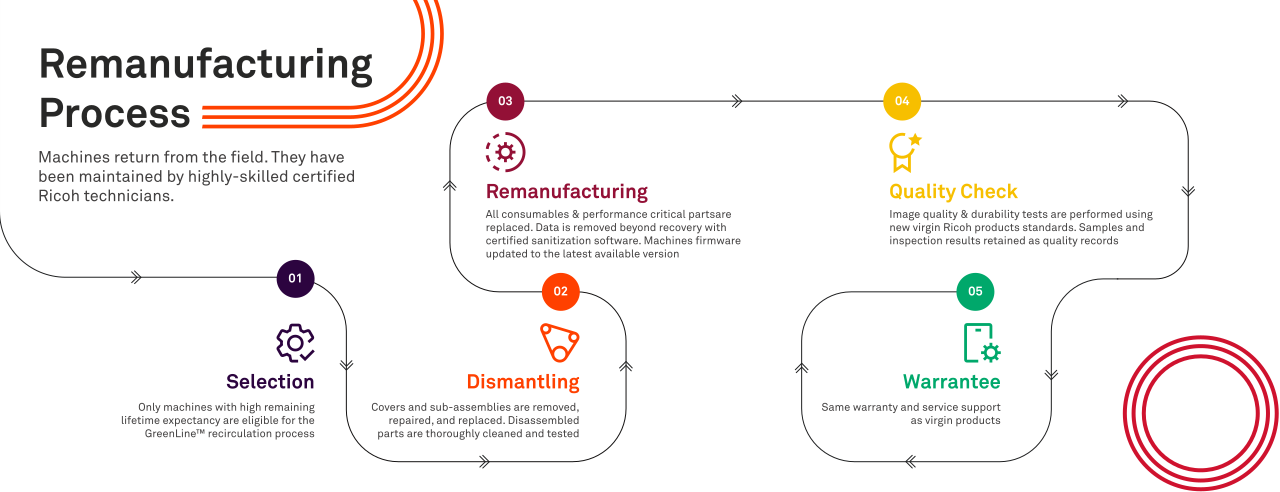
IDC, a leading research firm, describes remanufactured products as “devices that have gone through a specific process of remanufacturing overseen by the OEM vendor. These are called ‘remanufactured to new’.”¹
They must meet stringent criteria, including memory, counters, quality assurance, warranty, certifications and more.
According to the “IDC MarketScape: Worldwide Hardcopy Remanufacturing 2025 Vendor Assessment,”² Ricoh is noted as a Leader due to its 30+ year history in device remanufacturing, GreenLine™ Series printers, eco-conscious products and toners, sustainability programs, and its future roadmap.
Why do companies choose remanufactured printers?
Remanufactured printers can offer cost savings, lowering the overall cost per page while delivering high performance when matched to a printing need. From a cost perspective, they can be 45% to 55% less than a new printer (depending on whether it is an MFP or production press).
Here is a quick review of how these eco-friendly printers save money and resources:
Lower energy bills with less electricity usage and energy-saving, certified designs (i.e. ENERGY STAR®)
Longer lasting supplies with remanufactured cartridges
Less frequent maintenance with lower usage
Lower usage due to default settings to auto-duplex
Paper and toner-saving controls save money and increase the device lifecycle, which decreases the total cost of ownership
Security controls like authentication and print-release reduce printing and related costs, while making audits easier and more compliant
The long-term cost savings of eco-friendly printers paired with helping the environment create a clear path for aligning with circular office ecosystems and a circular economy.
Here’s what the data tells us — and why it’s important
The desire to adopt circular sustainable practices is growing, especially when you consider these statistics:
In a 2024 report, the world generated a record 62 million tons of e-waste in 2022, and that number is expected to rise to 82 million tons by 2030. Yet only 22.3% of this waste was properly collected and recycled.³
93% of business information continues to be produced on paper. Annually, this culminates in the production of an astonishing 21 million tons of paper waste by American businesses.⁴
Every year, U.S. offices use 12.1 trillion sheets of paper and 45% of office paper is discarded by the end of the day.⁵
Recycling 1 ton of office paper saves 17 trees, 3 cubic yards of landfill space and 4,100 kWh of energy, showing a clear benefit of sustainable practices and cost savings.⁶
71% of employees make a point of ethical consideration on a company’s environmental impact when looking for a potential employer, demonstrating the changing values of the workforce.⁷
With more importance given to employee values and the enormous amount of reported waste in offices, as reported above, combined with significant lower pricing (~50%) on remanufactured devices, the evidence makes a strong business case to shift to a circular office ecosystem.
Even more convincing is data from a United Nations Environment Programme’s report that states failing to adopt circular practices could cost the world $640.3 billion annually by 2050. And, preventative measures could save $270.2 billion each year, and fully embracing circularity could generate a net gain of $108.5 billion annually.⁸
A great addition to an organization’s print strategy — remanufactured printers
To start making an eco-friendly impact on your business and bottom line, it’s time to consider remanufactured printers. Here’s some of the many benefits that address environmental challenges:
Reducing demand for raw materials like plastics, metals and rare earth elements
Extending product lifecycles, which lowers the volume of devices sent to landfills, and consequently lowers CO2 emissions
Minimizing energy use during manufacturing and operation
Supporting closed-loop recycling programs for consumables like toner cartridges
Beyond environmental impact, remanufactured printers offer compelling business advantages:
Cost efficiency — Remanufactured devices cost less than new models, while delivering comparable performance and reliability.
Supply chain resilience — With global disruptions affecting access to new hardware, remanufactured options provide a stable alternative.
Brand reputation — As customers and employees increasingly value sustainability, choosing remanufactured equipment signals environmental leadership.
Compliance and reporting — Circular practices support sustainability goals and help meet regulatory requirements around waste reduction and CO2 emissions.
As a leader dedicated to a circular economy and sustainable printing, Ricoh offers its GreenLine Series of certified, remanufactured devices to help organizations reduce e-waste, cut costs and lead the way in circular office innovation.
The like-new GreenLine MFPs and printers are reliable, high-quality, cost-effective and have optional software and firmware to streamline work processes — and, of course, they meet all the rigorous criteria and sustainability features. Data cleansing is also an important part of the process of ensuring security and compliance.
Our commitment to the environment and our GreenLine Series continues to grow. We’ve remanufactured over 370,000 devices, 2.2 million toner cartridges, harvested over 700,000 parts, 87,000 cores, and over 195,000 TCRU. Depending on the model, we return between 72% to 97% of post-consumer weight to service rather than being scraped or recycled.
A sustainable path forward
At the heart of a circular office is a simple but powerful shift: moving from a “take-make-dispose” model of office printers to one that keeps products and materials in use for as long as possible.
As the circular economy and circular office ecosystem continue to evolve, forward-thinking organizations will look beyond recycling and embrace full lifecycle strategies — from design and procurement to usage and end-of-life management.
Ready to reimagine printing in your workplace?
We specialize in helping our customers find savings opportunities in their organizations. From our Intelligent Managed Print Services to our GreenLine™ Series, you have a lot of options to achieve new sustainable and cost-efficient ways to run your office and inspire a new cultural mindset.
Ready to get started?
About the Author
Marty Hazen
Senior Manager II, Baja Operations, Supply Chain, Ricoh USA

Articles by Marty Hazen
Remanufactured printers supporting efficiency
Remanufactured printers are proving cost effective, productivity enhancers, especially for hybrid work places.
Remanufactured devices help meet sustainability goals
Remanufactured devices have become a powerful, forward-looking strategy that meets both sustainability and cost saving objectives.
The role of remanufactured printers in fleets today
Cost, performance, and reliability are key to equipment decisions. Today, so do environmental factors, which can help improve those key elements too.
Recommended for you
 Articles
Is remanufactured the same as refurbished?
We discuss the differences, why it matters, and how to make the right choice for your organization.
 Articles
Remanufactured printers supporting efficiency
Remanufactured printers are proving cost effective, productivity enhancers, especially for hybrid work places.
 Articles
Remanufactured devices help meet sustainability goals
Remanufactured devices have become a powerful, forward-looking strategy that meets both sustainability and cost saving objectives.
- 1IDC. “IDC MarketScape: Worldwide Hardcopy Remanufacturing 2025 Vendor Assessment.” March 2025, IDC #EUR153222025.
- 2IDC. “IDC MarketScape: Worldwide Hardcopy Remanufacturing 2025 Vendor Assessment.” March 2025, IDC #EUR153222025.
- 3United Nations Institute for Training and Research. “Global e-Waste Monitor 2024: Electronic Waste Rising Five Times Faster than Documented E-waste Recycling.” March 20, 2024.
- 4OfficeDasher. “Office Paper Consumption Statistics: The Key Numbers in 2025.” July 3, 2025.
- 5OfficeDasher. “Office Paper Consumption Statistics: The Key Numbers in 2025.” July 3, 2025.
- 6WorldMetrics. “WORLDMETRICS.ORG REPORT 2025 Office Paper Consumption Statistics.” May 1, 2025.
- 7Market.Biz. “Workplace Sustainability Statistics and Facts.” August 19, 2025.
- 8United Nations Environment Programme. “Global Waste Management Outlook 2024