
What is Internet of Things (IoT) device monitoring?
Internet of Things (IoT) device monitoring is the process of tracking the health, performance, security, and operational status of connected devices across a network.
As more devices become connected, keeping track of their performance becomes increasingly important. IoT device monitoring collects and analyzes data from these connected devices so teams can quickly see how equipment is performing and address issues before issues arise.
IoT devices can include printers, sensors, security cameras, environmental controls, manufacturing equipment, building systems, and other technologies connected on your network. Effective IoT device monitoring helps organizations gain visibility into connected environments, allowing teams to monitor performance, identify issues early, and respond faster when problems arise.
Why is Internet of Things (IoT) device monitoring important?
Managing a handful of connected devices is one thing, but managing hundreds or thousands of devices across multiple locations can become difficult to maintain for most teams. IoT device monitoring helps teams maintain visibility, improve reliability, and reduce the operational burden of supporting connected technology.
Key benefits include:
Improved visibility: View device health and status from a centralized dashboard.
Faster issue detection: Identify problems before they get out of hand.
Increased uptime: Support proactive maintenance and reduce unexpected downtime.
More efficient support: Enable remote monitoring and troubleshooting.
Smarter planning: Use device data to support maintenance and asset management decisions.
Enhanced security oversight: Monitor activity that may indicate potential security concerns.
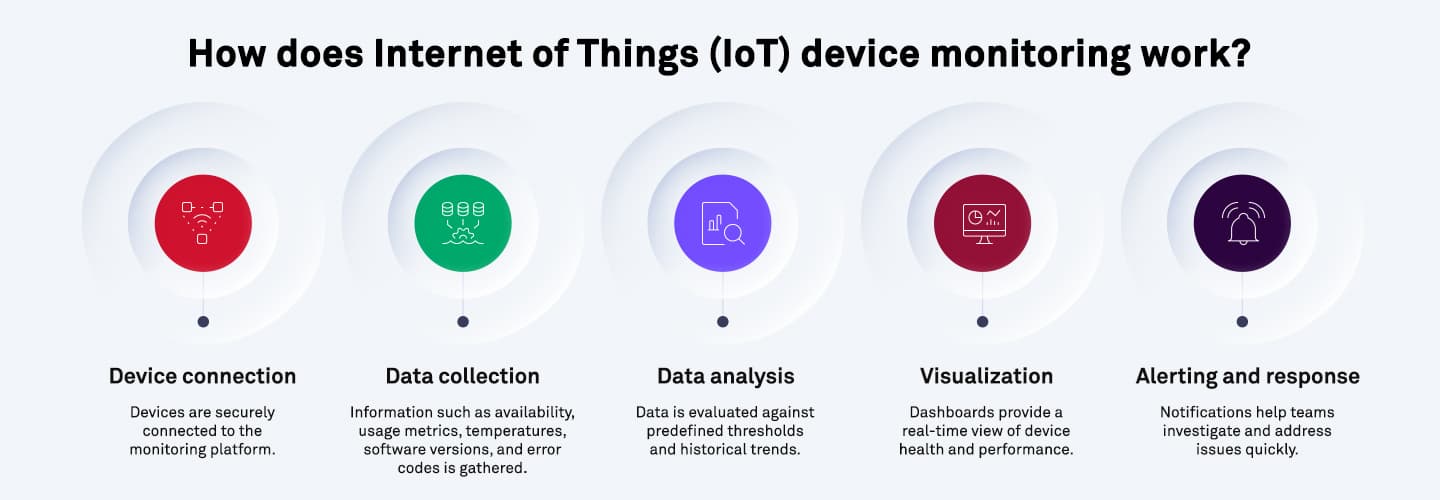
How does Internet of Things (IoT) device monitoring Work?
IoT monitoring platforms gather data from connected devices and turn it into actionable insights for IT, facilities, operations, and service teams.
A typical monitoring process includes:
Device connection: Devices are securely connected to the monitoring platform.
Data collection: Information such as availability, usage metrics, temperatures, software versions, and error codes is gathered.
Data analysis: Data is evaluated against predefined thresholds and historical trends.
Visualization: Dashboards provide a real-time view of device health and performance.
Alerting and response: Notifications help teams investigate and address issues quickly.
What are some examples of IoT device monitoring?
IoT monitoring is commonly used for:
Network-connected printers and multifunction devices
Environmental and occupancy sensors
Security cameras and access control systems
Manufacturing and industrial equipment
Building automation and HVAC systems
Transportation and logistics tracking devices
Connected technologies are helping businesses improve visibility across a wide range of industries. As explored in this article on IoT applications in retail and manufacturing, connected devices can provide real-time insights that support efficiency, maintenance, and operational decision-making.
Commonly asked questions
What types of devices can be monitored?
Most connected devices that provide any type of operational data can be monitored. Devices like printers, sensors, cameras, industrial equipment, access control systems, and building management technologies to name a few.
What data does IoT device monitoring collect?
Collected data varies by device but often includes status information, usage metrics, software versions, environmental readings, error codes, and maintenance information.
Is IoT device monitoring the same as device management?
No. Monitoring focuses on tracking performance and generating alerts. Device management typically includes tasks such as configuration changes, software updates, policy enforcement, and remote remediation.
Can IoT monitoring support predictive maintenance?
It can. Historical and real-time data can help identify patterns that may indicate developing concerns, allowing teams to address problems before issues arise.
Further insights

IoT Command Center
Real-time problem detection and resolution, and analytics, from a device agnostic platform.
 Articles
Unlocking the power of IoT in retail and manufacturing
See how IoT devices are improving operations across stores, warehouses and factories.
 Articles
Field service delivery with merged reality
How use of new IoT tool helps speed service calls to reduce equipment downtime.